Verified
Supplier
Associate Member
Read our latest customer reviews
View reviews →Read our latest customer feedback
View our reviews →At EnviroPass, we provide professional daylight and sunlight assessments that give planning authorities the technical evidence they need to determine your application with confidence. Whether you are an architect, developer, or homeowner, our reports are structured to satisfy local planning authority requirements and delivered fast.
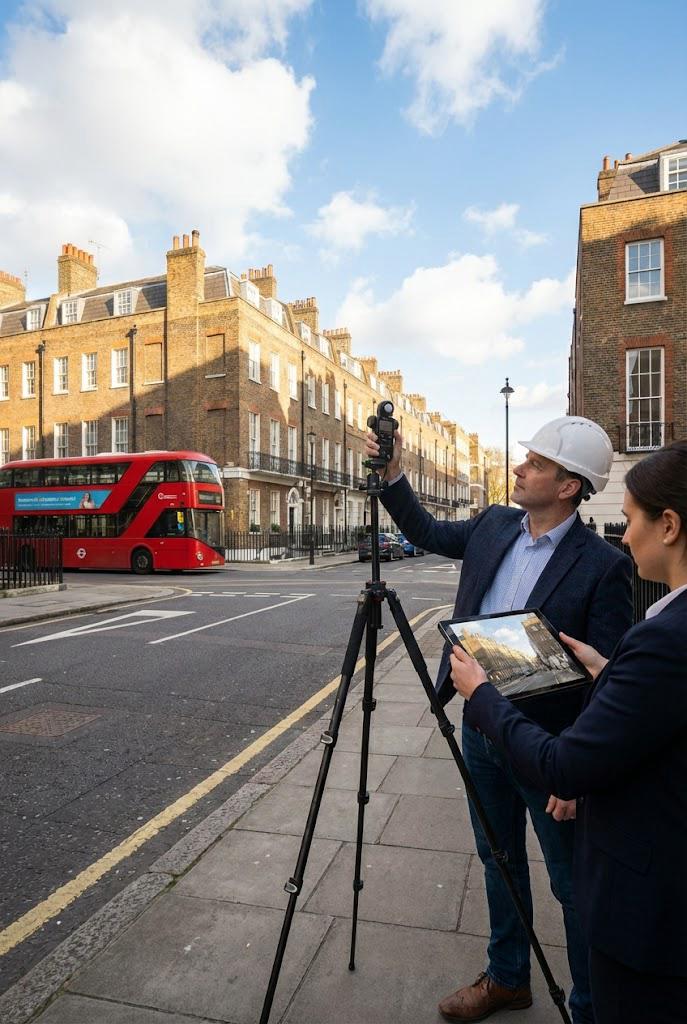
A daylight and sunlight assessment is a technical study that calculates how a proposed development affects the natural light reaching existing neighbouring properties and the new spaces being created. It is one of the most commonly requested technical reports in the London planning process.
The assessment examines internal daylight to habitable rooms such as living rooms, bedrooms, kitchens and dining spaces, sunlight reaching windows and outdoor amenity areas including gardens, courtyards and communal spaces, and daylight impact and overshadowing of neighbouring properties, open land and key amenities.
Our assessments follow the methodology set out in the BRE Guide: Site Layout Planning for Daylight and Sunlight: A Guide to Good Practice, 3rd Edition (2022) by P.J. Littlefair, alongside British Standard BS EN 17037:2018, which sets out the requirements for internal daylight performance in new buildings.
Local planning authorities across England, Wales and Scotland regularly request these reports when a development has the potential to reduce natural light to neighbouring buildings or create overshadowing.
If you are unsure whether your project requires an assessment, contact us and we will advise you within the hour.
EnviroPass applies the full suite of BRE-recommended tests to measure daylight and sunlight impact accurately. These are compared against recognised advisory thresholds to determine whether any reduction is likely to be noticeable or harmful to amenity.
VSC measures the proportion of visible sky seen from the centre of a window at facade level. Where a proposed development would reduce the VSC of a neighbouring window below 27%, or below 80% of its existing value, this is considered likely to be noticeable and requires professional justification.
The NSL test evaluates how much of a room's floor area retains a view of the sky through its window under both existing and proposed conditions. A reduction below 80% of the original distribution suggests occupants may experience a meaningful loss of natural light and may need to rely more heavily on artificial lighting.
APSH calculates the hours of direct sunlight reaching a window over a full year and during the winter period. Where reductions exceed the BRE advisory thresholds, the impact on the comfort and amenity of occupants is assessed with professional judgement.
Used for proposed new dwellings, daylight provision is the primary metric under BS EN 17037:2018 for assessing whether internal spaces within a new building will receive adequate levels of natural light.
Outdoor amenity areas including private gardens, communal courtyards and play areas are tested to determine whether they will continue to receive at least two hours of direct sunlight on 21 March, the spring equinox. This test is particularly relevant for residential developments and is a common point of scrutiny in planning decisions.
We begin by establishing the scope of the assessment and gathering all relevant baseline information, including architectural drawings, a 3D model of the proposed development and its surroundings, window and room schedules for neighbouring properties, and the location of any external amenity spaces to be assessed.
Our consultants build a precise 3D model of the site, existing and proposed, using specialist daylight and sunlight modelling software. This allows us to calculate accurate before-and-after values for every receptor identified in the brief.
We apply the BRE-recommended tests, including VSC, NSL, APSH, ADF and amenity space sunlight, to each receptor. We compare results against BRE guidance thresholds and form professional judgements on the significance of any reductions in the context of the surrounding built environment.
We prepare a clearly structured planning report that includes baseline conditions, predicted impacts, illustrated shadow diagrams, tabulated results and a professional conclusions section. Our reports are formatted to meet the expectations of local planning authorities and are suitable for submission with planning applications.
We have delivered daylight and sunlight assessments across a wide range of development types and scales throughout the UK.
We assessed the daylight and sunlight impact of a proposed extension on the neighbouring property and its garden, carrying out both a VSC and NSL analysis of affected windows and an overshadowing assessment of the adjoining amenity space.
This large-scale development comprised 233 residential apartments under Use Class C3 alongside three commercial units with flexible Class E uses. EnviroPass delivered a comprehensive neighbouring and internal daylight assessment, testing the impact on surrounding receptors and verifying adequate daylight levels within the proposed dwellings.
We assessed the impact of the proposed extension on windows of neighbouring properties and their associated outdoor amenity spaces, providing VSC, NSL and amenity space sunlight analysis in support of the planning application.
We carried out an internal daylight assessment across all habitable rooms within the proposed development, using ADF calculations under BS EN 17037:2018 to demonstrate that the new dwellings would receive adequate natural light.
This conversion scheme involved the change of use of an educational building to residential accommodation. EnviroPass carried out an internal daylight assessment to demonstrate that the proposed habitable rooms would achieve the daylight performance required under current planning and building standards.
Daylight and Sunlight Assessments are required by planning authorities to check that new developments provide good daylight inside rooms and do not negatively affect neighbouring windows or gardens.
For internal assessments, we follow BS EN 17037 to measure daylight distribution and sunlight exposure.
For external assessments, we follow BRE 209 to assess neighbour impact, including VSC, APSH, and overshadowing.
Our assessments use trusted methods, following the BRE Guide: Site Layout Planning for Daylight and Sunlight - A Guide to Good Practice, 3rd Edition (2022) by P.J. Littlefair, with clear reporting to help your project achieve the right daylight and sunlight levels and gain planning approval without delays.



Our dedicated professionals ensure thorough and accurate assessments for each project. We are steadfast in our commitment to delivering clarity and understanding for out clients.
Most UK local authorities require a Daylight and Sunlight assessment if your development is multi-storey, located near existing residential windows, or significantly larger than the building it replaces. Enviropass provides the technical reports needed to validate your application and prove that your scheme respects the "amenity" of the local area.
BRE 209 is the industry-standard "Guide to Good Practice" used by planning officers to judge light impact. The 2022 update introduced stricter alignment with European standards. Enviropass ensures your project is assessed against these latest benchmarks, preventing your application from being judged by outdated—and therefore invalid—criteria.
The cost depends on the number of "receptors" (neighbouring windows) and the complexity of the 3D model. Enviropass offers competitive, transparent fee structures. We focus on delivering high-accuracy environmental consultancy services that provide real value by de-risking your planning journey.
VSC is the primary measure of "skylight" reaching a window. If a new development reduces a neighbour’s VSC to below 27% (or less than 0.8 times its former value), it often triggers a planning objection. Enviropass uses advanced 3D modelling to calculate exact VSC levels, providing the data needed to justify your building's massing.
The 45-degree rule is a "rule of thumb" used by planners to spot potential light issues. If you fail this, you will likely need a formal Daylight and Sunlight assessment to prove that the actual impact is acceptable. Enviropass specializes in these detailed studies, often proving that a "rule of thumb" failure doesn't necessarily mean a loss of amenity.
This is a critical distinction: Daylight and Sunlight is a planning matter (amenity), while Right to Light is a legal matter (easements). Enviropass focuses on the planning side, ensuring your project meets local authority requirements to get your permission granted, while advising on potential legal risks.
APSH measures the amount of direct sunshine a window receives throughout the year. For a room to be "well-lit," it typically needs 25% of annual hours, including 5% in winter. Enviropass provides these precise calculations to ensure your development offers a high standard of living for future occupants.
Yes, the BRE guidelines state that at least 50% of an amenity space should receive at least two hours of sunlight on the 21st of March. Enviropass produces shadow plots and "Sun-on-Ground" diagrams that clearly demonstrate your project won't leave neighbouring gardens in the dark.
Absolutely. By conducting "massing studies" early, Enviropass can help you determine the maximum possible height and "bulk" of a building before it starts to negatively impact neighbours. This allows you to maximize your site's GDV (Gross Development Value) while remaining within planning limits.
The NSL test tracks which parts of a room can "see" the sky. If the area of the room that can see the sky is reduced significantly, the council may view the development as harmful. Enviropass provides internal daylight distribution maps to help you optimize window placement and room layouts.
Trees are generally not included in the "baseline" because they can be removed or die. However, they are increasingly considered in "mitigation" discussions. Enviropass can provide a nuanced analysis that balances your ecological surveys and BNG plan with your daylight requirements.
Sometimes. High-density planting for a BNG plan can shade lower-floor windows. As a multi-disciplinary environmental consultancy, Enviropass ensures your landscaping strategy and daylight strategy work in harmony, preventing one environmental benefit from causing a planning failure elsewhere.
ADF was the old way of measuring internal light. Under the new 2022 standards (BS EN 17037), we now look at "Target Illuminance" across the room. Enviropass uses these modern metrics to ensure your new homes are bright, airy, and compliant with current Building Regulations.
Depending on the size of the project, a professional report usually takes 5 to 10 working days. Enviropass offers a rapid turnaround service to meet tight planning deadlines, ensuring your technical data is ready for the committee.
Yes, and they are high-risk. Subterranean units often struggle to meet light targets. Enviropass uses "Climate-Based Daylight Modelling" (CBDM) to prove that through lightwells and reflective surfaces, even basement units can provide high-quality habitable space.
CBDM is a sophisticated simulation that uses real weather data to predict light levels every hour of the year. Enviropass uses this to provide a more realistic and "defensible" data set than simple static tests, which is often a key factor in winning appeals.
Yes. If a neighbour objects based on "loss of light," a professional report from Enviropass often proves their concerns are exaggerated or that the impact remains within BRE-accepted thresholds, giving the planning officer the evidence they need to approve your scheme.
The BRE guidelines suggest that a 20% reduction is "noticeable." However, in dense urban areas like London, higher reductions are often considered "acceptable" due to the context. Enviropass provides the written justification to help planners apply "flexibility" to your project.
While the focus is usually on residential properties, offices and schools also require adequate light. Enviropass assesses commercial schemes to ensure they provide a productive work environment and comply with BREEAM standards.
Deep balconies can severely restrict light to the units beneath them. Enviropass works with your architects to "stagger" balconies or use glass balustrades, ensuring you meet your BNG plan requirements for outdoor space without failing your daylight tests.
This is a video-style simulation showing exactly where a shadow falls throughout the day. Enviropass produces these visual aids to help planning committees—and local residents—visualize the actual impact of a tall building, often de-escalating local opposition.
The rules are the same, but the "flexibility" is often higher. Enviropass understands how to frame your Daylight and Sunlight assessment within the context of heritage and high-density urban living, helping you win approval in sensitive locations.
If you are building near an existing development, you are the "Agent of Change." You must ensure your building doesn't unfairly restrict their existing light. Enviropass protects your legal and planning position by assessing these impacts before you submit.
Yes. Many councils now require daylight proof for "office-to-residential" conversions to ensure they aren't creating "substandard" housing. Enviropass provides these fast-track reports to secure your Prior Approval quickly.
Because we don't just provide "Fail" or "Pass" marks—we provide solutions. If your design fails a test, Enviropass will suggest the "massing tweaks" or window changes needed to get it over the line. We are your partners in planning success.
As early in the design process as possible. Identifying any light-related constraints before plans are
finalised gives architects and designers room to adjust massing, height or window positions at minimal
cost. Discovering a problem after submission can lead to objections, redesign requests or refusal.
Not necessarily. A loss of daylight or sunlight to a neighbouring property does not make a development
automatically unacceptable. The BRE guidelines provide advisory thresholds that planners use to assess
the significance of any reduction, and professional judgement is applied in the context of the site — for
example, a denser urban setting may tolerate greater reductions than a suburban location. Where
results fall outside the thresholds, we will work with you to explore design options that bring impacts
within acceptable limits.
EnviroPass assessments start from £650 + VAT. The exact fee depends on the scale and complexity of the
development, the number of receptors to be tested, and the scope of reporting required. Contact us for
a tailored quote — we respond within one hour.
We are known for fast turnaround times without compromising on accuracy. We will confirm a realistic
delivery programme when you contact us.
All our assessments are carried out in accordance with:
- *BRE Guide: Site Layout Planning for Daylight and Sunlight: A Guide to Good Practice*, 3rd Edition
(2022) by P.J. Littlefair
For those exploring "Daylight and Sunlight Assessments & Reports near me," we're proud to serve the entirety of the London region. We hold each project to the highest standards of quality and compliance.
For a deeper dive into Planning Applications in London, consider visiting The City of London's Official Planning Website.
Whether you need a simple extension assessment or a large commercial impact study, our team will review your project and provide a clear fixed-fee quotation.
Request a Free Quote
Sign up to receive our latest updates, information and insights.